
Why Do Outdoor Lights Crack in Hot Climates?
Outdoor lighting installed in a hot climate faces a very different environment from lighting used in a mild climate.
Strong sunlight, high temperatures, UV exposure and repeated temperature changes can gradually affect the materials used in an outdoor fixture.
So, why do outdoor lights crack in hot climates?
The answer is usually not one single factor.
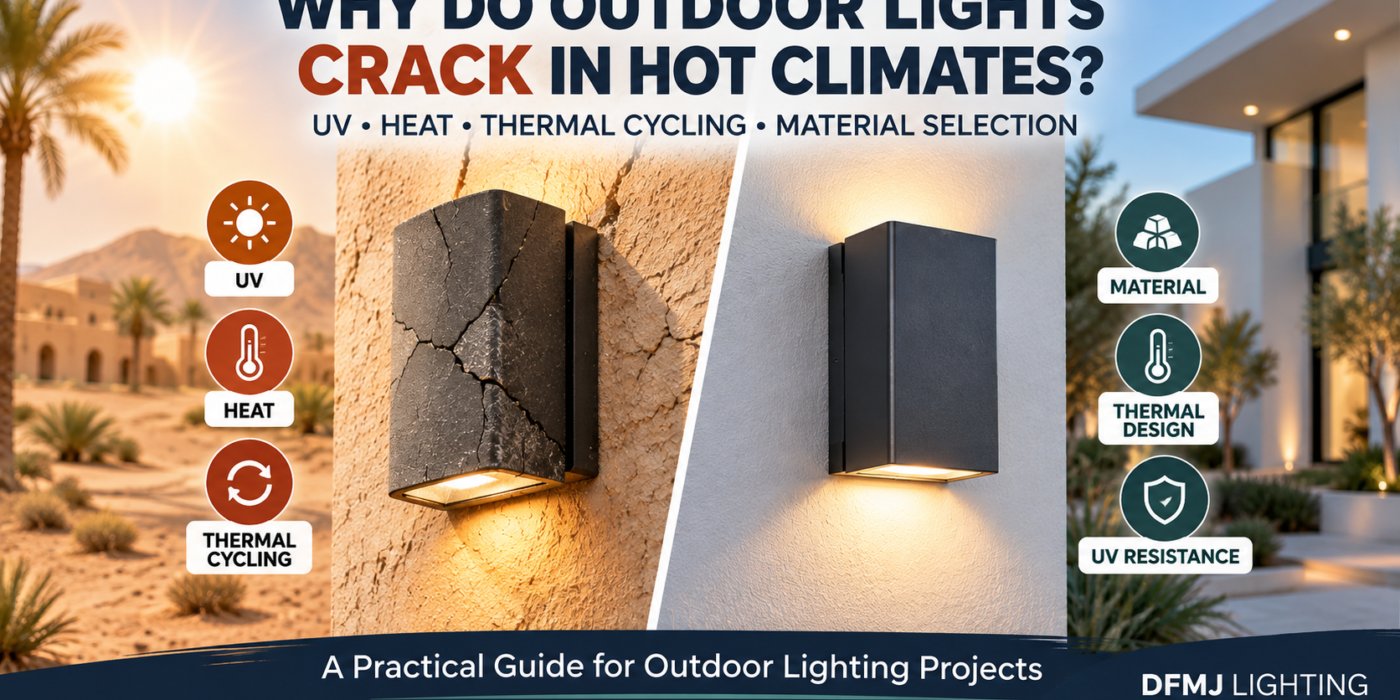
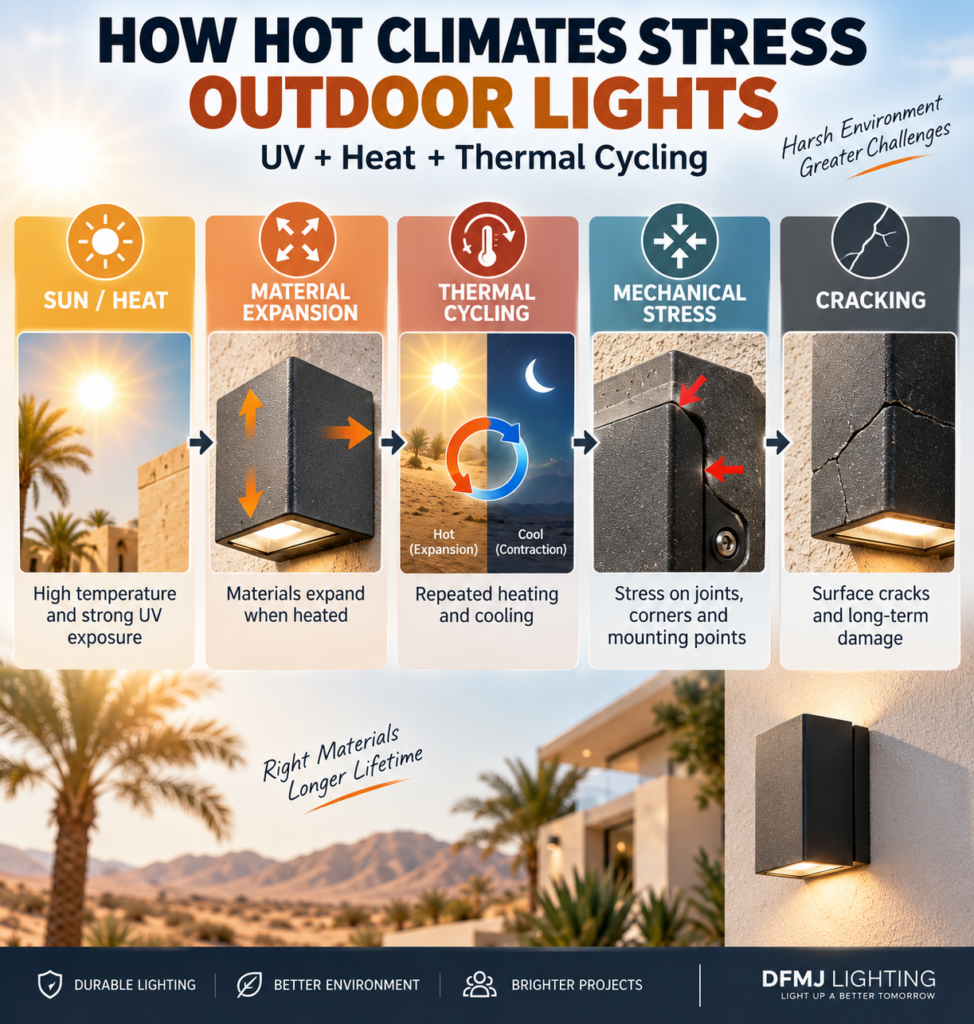
Cracking can happen when UV exposure, heat, thermal expansion and contraction, material aging, mechanical stress and fixture design work together over time.
This matters for projects in regions such as the Middle East, Australia, Africa and South Asia, where outdoor lighting may be exposed to intense sunlight and high ambient temperatures.
For B2B buyers, the important question is not simply:
“Is this outdoor light waterproof?”
It is also:
“Is this fixture designed for the environment where it will be installed?”
Quick Answer: Why Do Outdoor Lights Crack in Hot Climates?
The most common causes include:
- Long-term UV exposure
- High ambient and surface temperatures
- Thermal expansion and contraction
- Plastic material aging
- Poor material selection
- Stress around screws, joints and mounting points
- Poor housing design and heat management
Not every plastic outdoor light will crack, and not every aluminum fixture is automatically suitable for a hot climate.
The key is to evaluate the material, design, finishing, components and application environment together.
1. UV Exposure Can Make Some Materials Brittle
One of the main factors behind outdoor lights crack in hot climates is long-term exposure to sunlight.
UV radiation can gradually affect polymers and other organic materials.
Depending on the material and formulation, long-term exposure may lead to:
- Discoloration
- Surface chalking
- Loss of mechanical strength
- Embrittlement
- Microcracks
- Visible cracking
This is particularly important for plastic housings, diffusers, covers, cable components and other polymer parts.
The problem usually does not appear immediately.
A product may look completely normal when it leaves the factory but change after prolonged outdoor exposure.
For plastics, ISO 4892 provides standardized methods for laboratory exposure to light sources and simulated weathering conditions. ISO 4892-3:2024, for example, covers fluorescent UV lamp exposure with heat and water to simulate aspects of outdoor weathering.
This is one reason buyers should ask not only “What plastic is used?” but also “What grade and weathering performance does it have?”
2. High Temperatures Put Additional Stress on the Fixture
Heat is another important factor when considering outdoor lights crack in hot climates.
An outdoor fixture can experience heat from two different sources:
Environmental heat
The fixture is exposed to high outdoor temperatures and direct sunlight.
Internal heat
LEDs, drivers and other electrical components generate heat during operation.
When these two sources combine, the temperature inside the fixture can become significantly higher than the surrounding air.
This can affect:
- Plastic components
- Gaskets
- Cable materials
- Diffusers
- LED drivers
- Internal connections
- Adhesives and sealing materials
This is why thermal management should be considered during product selection, especially for outdoor lighting used in hot regions.
A fixture designed for a moderate climate should not automatically be assumed to perform the same way in a high-temperature environment.
3. Thermal Expansion and Contraction Can Create Stress
Another important reason outdoor lights crack in hot climates is thermal cycling.
Materials expand when heated and contract when cooled.
Outdoor fixtures may experience repeated temperature changes between:
Hot afternoon → cooler evening → hot afternoon again
Different materials can also expand at different rates.
For example, a fixture may contain:
- Aluminum housing
- Plastic diffuser
- Rubber gasket
- Screws
- Glass
- Internal electronic components
These materials do not necessarily respond to temperature changes in exactly the same way.
Over many heating and cooling cycles, stress can develop around:
- Screw holes
- Corners
- Mounting points
- Thin plastic sections
- Housing joints
- Interfaces between different materials
This does not mean thermal expansion will automatically cause cracking.
The risk depends on the material properties, fixture geometry, assembly method and operating environment.
That is why good outdoor lighting design considers the entire construction rather than selecting materials individually.
4. Plastic Aging Can Become a Long-Term Problem
Plastic is not automatically a poor choice for outdoor lighting.
The important question is which plastic, in which application, under which environmental conditions.
Different polymers have different levels of UV resistance, temperature resistance, impact strength and weatherability.
Poorly selected or insufficiently stabilized plastic may gradually become:
- Harder
- More brittle
- Discolored
- Less impact resistant
- More vulnerable to cracking
For an outdoor lighting project, buyers should therefore ask the supplier about the actual material specification instead of simply accepting the word “plastic.”
For example:
What material is it?
What grade is it?
Is it UV stabilized?
Where is it used in the fixture?
What environmental conditions was it designed for?
These questions become especially important when outdoor lights crack in hot climates after long-term exposure.
5. Material Selection Matters More in Hot Climates
Material selection is one of the most important parts of outdoor lighting design.
For many outdoor architectural fixtures, die-cast aluminum provides a useful combination of:
- Structural strength
- Heat dissipation
- Dimensional stability
- Durable housing construction
- Compatibility with protective surface finishes
However, aluminum is not automatically the answer to every outdoor lighting application.
A complete fixture may still contain:
- Plastic diffusers
- Gaskets
- Cable glands
- Connectors
- Driver components
- Screws
- Adhesives
Each component needs to be appropriate for the intended environment.
This is why outdoor lights crack in hot climates can rarely be explained by the housing material alone.
A strong aluminum housing with a poorly selected diffuser or gasket can still create a long-term reliability problem.
6. Housing Design Can Be More Important Than Material Alone
Two outdoor lights can use the same material but perform differently.
Why?
Because product design matters.
A well-designed housing should consider:
- Wall thickness
- Internal component position
- Heat dissipation
- Drainage
- Sealing
- Mounting points
- Screw locations
- Material transitions
- Expansion and contraction
- Accessibility for maintenance
Thin sections and sharp corners can create areas of higher mechanical stress.
Similarly, excessive heat accumulation around the driver or LED module can increase thermal stress inside the fixture.
This is why I would not evaluate an outdoor lighting product simply by asking:
“Is it aluminum or plastic?”
The better question is:
“How was the fixture engineered?”
7. Installation Can Also Contribute to Cracking
The final factor is installation.
Even a well-designed outdoor fixture can be damaged during installation if excessive force is applied.
For example:
- Over-tightening screws
- Using incorrect mounting hardware
- Installing on an uneven surface
- Applying excessive pressure to plastic parts
- Damaging the housing during installation
- Blocking designed ventilation or drainage areas
Small installation stresses may not cause an immediate failure.
But when combined with heat, UV exposure and repeated thermal cycling, they may contribute to long-term cracking.
For project buyers, installation instructions should therefore be treated as part of product quality—not as an afterthought.
How to Choose Outdoor Lights for Hot Climates
If you are sourcing outdoor lighting for the Middle East, Australia, Africa, South Asia or another hot region, I recommend looking at the complete fixture.
1. Check the Housing Material
Ask whether the housing is die-cast aluminum, plastic or another material.
Then ask why that material was selected for the application.
2. Check UV Resistance
For exposed plastic components, ask about UV-resistant materials, UV stabilization or relevant weathering tests.
3. Check Thermal Management
Understand how heat from the LED and driver is managed.
A higher-power fixture requires particularly careful thermal design.
4. Check the Diffuser
Do not only check the main housing.
The diffuser or lens may also be exposed to direct sunlight and high temperatures.
5. Check Gaskets and Sealing Materials
Hot climates can accelerate aging of some sealing materials.
Ask the supplier what materials are used and where they are applied.
6. Check the Product Design
Look at corners, joints, mounting points, screw holes and interfaces between different materials.
7. Test a Sample
For a large project, a sample installation can provide useful information before the bulk order is produced.
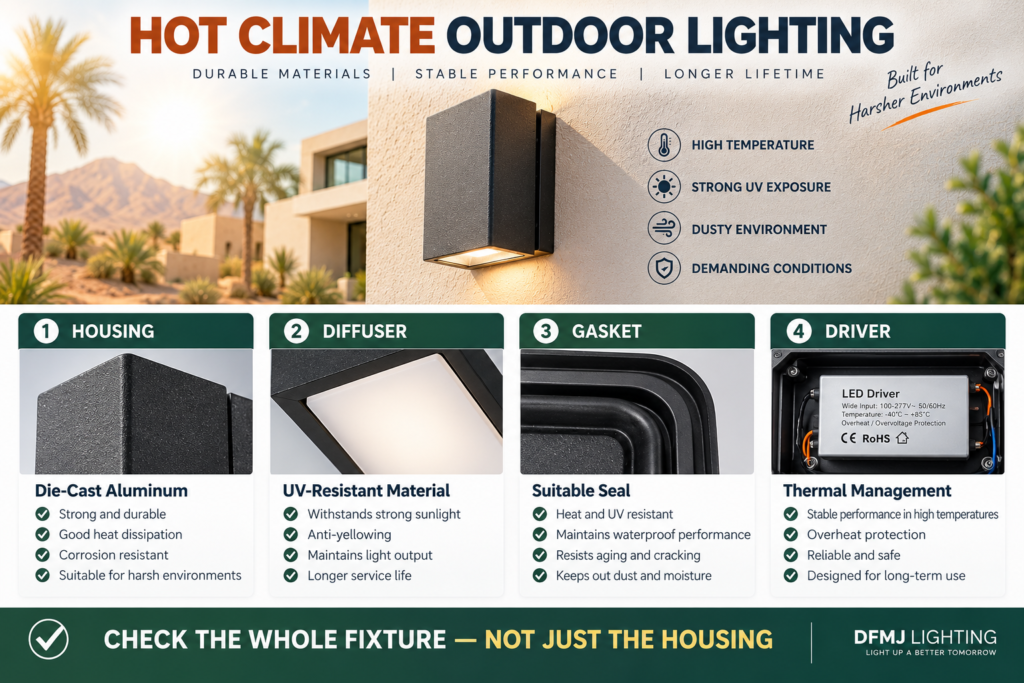
DFMJ Expert Insight: Material Selection Is a System Decision
From a manufacturing perspective, I would not answer why do outdoor lights crack in hot climates with one material recommendation.
There is no single material that automatically makes an outdoor fixture suitable for every climate.
For example, when we look at a fixture intended for a high-temperature market, I would consider:
Housing → Diffuser → Gasket → Driver → Cable → Coating → Assembly → Thermal Design
The environment also matters.
A villa in a dry, high-temperature region may have different requirements from a coastal hotel with high heat, humidity and salt exposure.
This is why I believe outdoor lighting should be specified according to the actual project environment, not simply according to a standard product description.
Real Project Tip: Tell Your Supplier Where the Lights Will Be Installed
One simple thing can improve the sourcing process:
Tell your supplier the actual project location.
Don’t only send:
“Please quote this outdoor wall light.”
Instead, provide information such as:
- Project country
- Outdoor or semi-outdoor installation
- Approximate climate
- Coastal or inland location
- Direct sunlight exposure
- Installation height
- Required IP rating
- Expected quantity
- Project application
For example:
“These outdoor wall lights will be installed on villas in a hot and sunny region with strong direct sunlight.”
That gives the manufacturer more useful information when recommending materials, coatings, drivers and construction.
The right product specification starts with the right project information.
How to Reduce the Risk of Cracking in Hot Climates
There is no single test or material that can guarantee that an outdoor light will never crack.
Instead, buyers should evaluate several factors together.
A practical checklist is:
- UV-resistant materials where appropriate
- Suitable housing material
- Good thermal management
- Appropriate diffuser material
- Suitable gasket and sealing materials
- Proper housing design
- Correct installation method
- Appropriate environmental testing
- Sample testing before bulk production
For plastic components, accelerated weathering tests can help compare material performance under controlled conditions.
For example, ISO 4892-3:2024 specifies fluorescent UV exposure methods involving UV radiation, heat and water to simulate aspects of outdoor weathering.
The test method is useful as a reference, but test results should still be interpreted according to the actual product, material and application.
Why Hot Climate Projects Need More Than an IP Rating
An IP rating is important for outdoor lighting, but it does not answer every question about hot-climate durability.
IP testing primarily addresses protection against the ingress of solids and water.
It does not automatically tell a buyer:
- How well a plastic will resist UV aging
- How the fixture handles thermal cycling
- How the driver performs at high temperatures
- How the diffuser will age
- How the coating will perform under long-term exposure
- How different materials interact during temperature changes
So when selecting outdoor lighting for a hot climate, think beyond:
IP65
and evaluate:
IP Rating + Materials + UV Resistance + Thermal Design + Construction + Testing
About DFMJ Lighting
DFMJ Lighting focuses on outdoor lighting for B2B buyers, distributors, wholesalers, contractors and project customers.
Our outdoor lighting range includes:
- Outdoor wall lights
- Garden lights
- Landscape lighting
- Outdoor step lights
- Outdoor inground lights
For projects in hot and demanding climates, product selection should consider the complete fixture rather than one specification alone.
Housing material, thermal management, waterproof construction, surface finishing, electrical components and application environment all need to work together.
DFMJ Lighting works with outdoor lighting projects where buyers need to evaluate product specifications, samples and production requirements before placing bulk orders.
FAQ: Outdoor Lights Crack in Hot Climates
Why do outdoor lights crack in hot climates?
Outdoor lights can crack because of a combination of UV exposure, high temperature, thermal expansion and contraction, material aging, mechanical stress and housing design. The exact cause depends on the material and fixture construction.
Does heat make plastic outdoor lights crack?
High temperature can accelerate material aging in some plastics, while repeated heating and cooling can create thermal stress. However, performance depends on the specific polymer, formulation, design and application.
Is die-cast aluminum better for hot climates?
Die-cast aluminum can provide good structural strength and heat dissipation for many outdoor lighting applications. However, the complete fixture still needs suitable diffusers, gaskets, electronics, finishing and thermal design.
Can UV radiation make outdoor lights crack?
Long-term UV exposure can degrade some polymers and coatings, potentially causing discoloration, embrittlement and cracking. UV resistance depends on the material formulation and protective measures.
Are IP65 outdoor lights suitable for hot climates?
IP65 addresses protection against dust and water jets, but it does not by itself guarantee suitability for high-temperature or high-UV environments. Buyers should also evaluate materials, thermal management and environmental requirements.
What should I ask an outdoor lighting supplier for a hot climate project?
Ask about housing and diffuser materials, UV resistance, thermal management, driver specifications, gasket materials, coating, IP rating, environmental testing and sample performance.
Final Takeaway
Why do outdoor lights crack in hot climates?
Usually, it is not one simple reason.
UV exposure, heat, thermal cycling, material aging, mechanical stress and product design can all contribute to the problem.
For B2B buyers, the better approach is to start with the project environment and then select the appropriate:
Material → Housing Design → Thermal Management → Sealing → Components → Testing
A product that performs well in one climate is not automatically the right choice for another.
For hot-climate outdoor lighting, material selection should start with the environment—not the price.
Related Articles
- Why Do Outdoor Lights Keep Failing? 7 Causes and How to Prevent It
- Why Do Outdoor Lights Get Water Inside? 7 Causes and How to Fix Them
- Die-Cast Aluminum vs Plastic Outdoor Lights: Which Is Better?
- Why Do Outdoor Lights Turn Yellow? Causes, Materials, and How to Prevent It
- IP65 vs IP66 vs IP67: Which Outdoor Lighting Rating Do You Need?
- Why Do Cheap Outdoor Lights Fail Early? 7 Problems Buyers Should Check