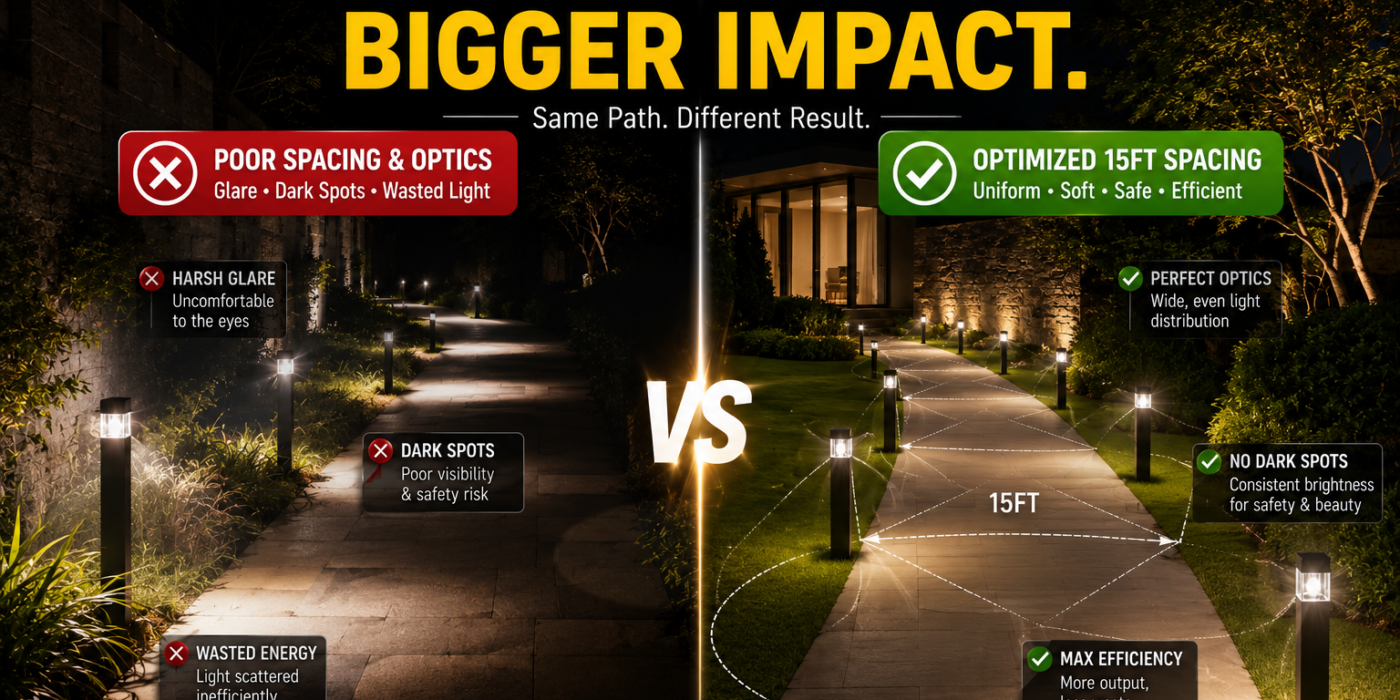

Have you ever walked down a commercial garden pathway and struggled to see the ground clearly because of alternating bright patches and pitch-black shadows? For landscape contractors, resort developers, and commercial project managers, figuring out how to space bollard lights correctly is not just an aesthetic decision—it is a critical safety and financial compliance issue.
If you space fixtures too far apart, you create dangerous “dark spots” that drastically increase the risk of trip-and-fall lawsuits. Conversely, placing them too close together creates blinding glare, violates local light trespass ordinances, and pointlessly inflates your procurement budget. Drawing from over a decade of commercial manufacturing and export experience, this guide breaks down the technical logic behind perfect pathway illumination, ensuring your next installation is both safe and highly cost-effective.
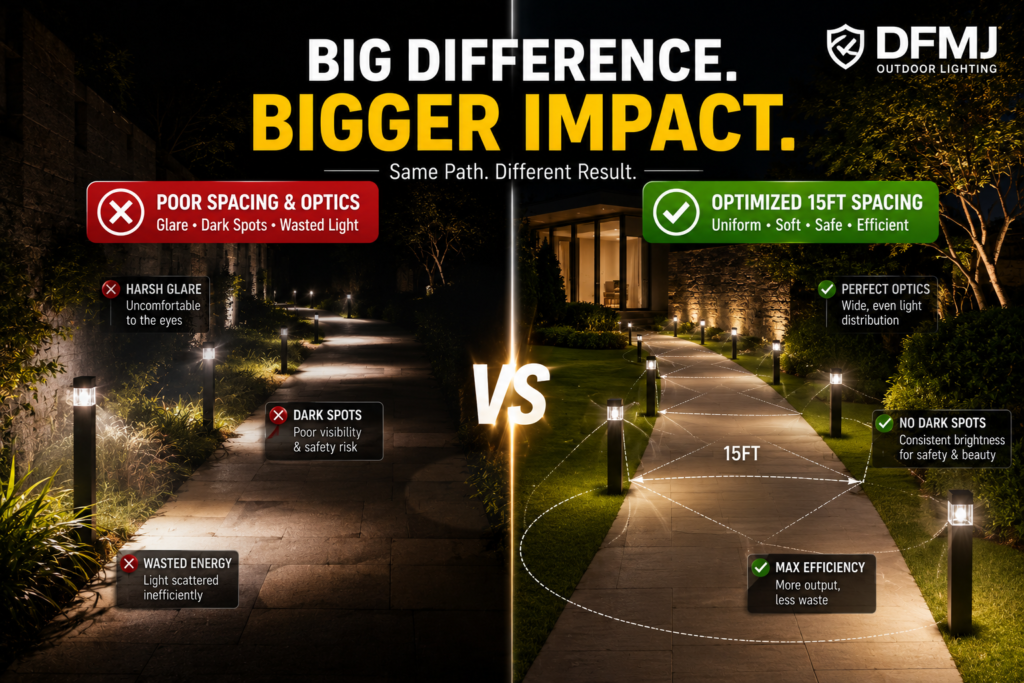
The Dangers of Incorrect Outdoor Bollard Light Spacing
Before diving into the calculations, it is crucial to understand the liabilities associated with improper lighting layouts. Commercial buyers must balance safety with budget efficiency. When you do not know how to space bollard lights optimally, your project is exposed to three major risks:
- The Dark Spot Liability: Uneven illumination leaves gaps in visibility. In commercial spaces, these dark patches mask uneven pavement or steps, leading to accidents and severe legal liabilities.
- The Glare and Light Trespass Problem: Over-lighting a pathway creates intense glare that blinds pedestrians. Furthermore, excessive light spilling into neighboring properties can fail municipal building inspections.
- The “Overstocked” Budget Trap: Ignorance of optical performance often leads contractors to over-purchase fixtures. Buying 50 standard lights when 30 precision-engineered lights would suffice wastes material costs, labor hours, and maintenance budgets.
How to Space Bollard Lights Based on Lumen Output
When contractors ask us how to space bollard lights, the first metric we analyze is the lumen output combined with the fixture’s optical design. A common industry misconception is that higher lumens automatically equal wider spacing. In reality, how the light is distributed (the beam angle) dictates the layout.
Here is a professional approach to calculating your spacing:
- Determine the Required Foot-Candles (Illuminance): For commercial walkways, a minimum of 0.5 to 1 foot-candle is generally required for safe pedestrian navigation.
- Check the Fixture’s Light Distribution: Identify if the fixture features a Type V (360-degree symmetrical) or Type IV (asymmetrical forward-throw) distribution.
- Identify the Radius of Illumination: Look at the photometric data provided by the manufacturer. If a 15W LED bollard provides 1 foot-candle at a radius of 6 feet, its total effective coverage diameter is 12 feet.
- Calculate the Overlap: To eliminate dark spots, the edges of the light pools must overlap by at least 15% to 20%. Therefore, for a fixture with a 12-foot coverage diameter, you should place the next fixture approximately 9 to 10 feet away.
Key Factors Influencing Pathway Lighting Layouts
Every landscape project has unique geographical and architectural constraints. To truly master how to space bollard lights, you must account for external environmental factors:
- Pathway Width: A narrow 3-foot walkway can typically be illuminated by a staggered zig-zag layout. A wide 8-foot commercial promenade may require parallel placement on both sides of the path.
- Fixture Height: Taller bollards (e.g., 40 inches) cast light over a wider area, allowing for extended spacing. Shorter fixtures (e.g., 24 inches) concentrate light locally and must be placed closer together.
- Regulatory Compliance: Always cross-reference your lighting plan with authoritative illumination standards to ensure compliance with minimum safety guidelines. IES recommended practices for exterior environments .
Why Advanced Optics Help You Buy Fewer Bollard Lights
The secret to optimizing your procurement budget lies in the internal reflector design of the fixture. Cheap retail lights rely on exposed LEDs that scatter light inefficiently, forcing you to buy more units to cover the same distance.
At DFMJ, our commercial-grade fixtures are engineered with specialized internal louvers and high-transmission PC diffusers. This directs the light downward and outward, maximizing the spread without causing upward light pollution. By upgrading to advanced optics, contractors can confidently increase the spacing between fixtures, cutting down the total quantity required for the project. : Explore our commercial outdoor bollard lights collection
We strictly ensure all our pathway lighting solutions meet international safety standards, including UL certification for the North American market. Furthermore, our logistics team seamlessly manages FOB Shenzhen Shekou shipping terms, guaranteeing that your high-efficiency fixtures arrive on schedule for your project deadlines.
Frequently Asked Questions (FAQ) About Pathway Illumination
What is the standard spacing for commercial bollard lights? As a general rule of thumb, commercial bollard lights should be spaced between 10 to 15 feet apart. However, this heavily depends on the lumen output, fixture height, and specific optical distribution of the light.
How do I prevent glare when spacing pathway lights? To prevent glare, choose bollards with “Dark Sky” compliant designs or internal louvers that direct light downward. Ensure you are not clustering high-lumen fixtures too close together, which creates blinding hotspots.
Do I need a symmetrical or asymmetrical light distribution? If you are placing the bollard in the center of a wide path or an open garden, a symmetrical (360-degree) distribution is best. If the bollard is at the very edge of a path next to a lawn, an asymmetrical distribution prevents wasting light on the grass and directs it onto the walkway.